

Key Takeaways:
- Relying on hope: A new study from CarShield and Money found that more than 50% of car owners have no repair-cost plan or contract. Of those, nearly 41% "mainly hope major repairs don't happen," and more than 17% don't actively manage the risk.
- Worried, unprotected: 62% of car owners with no service contract are very or extremely worried about a major repair bill. About 12% of all respondents rely on a vehicle service contract.
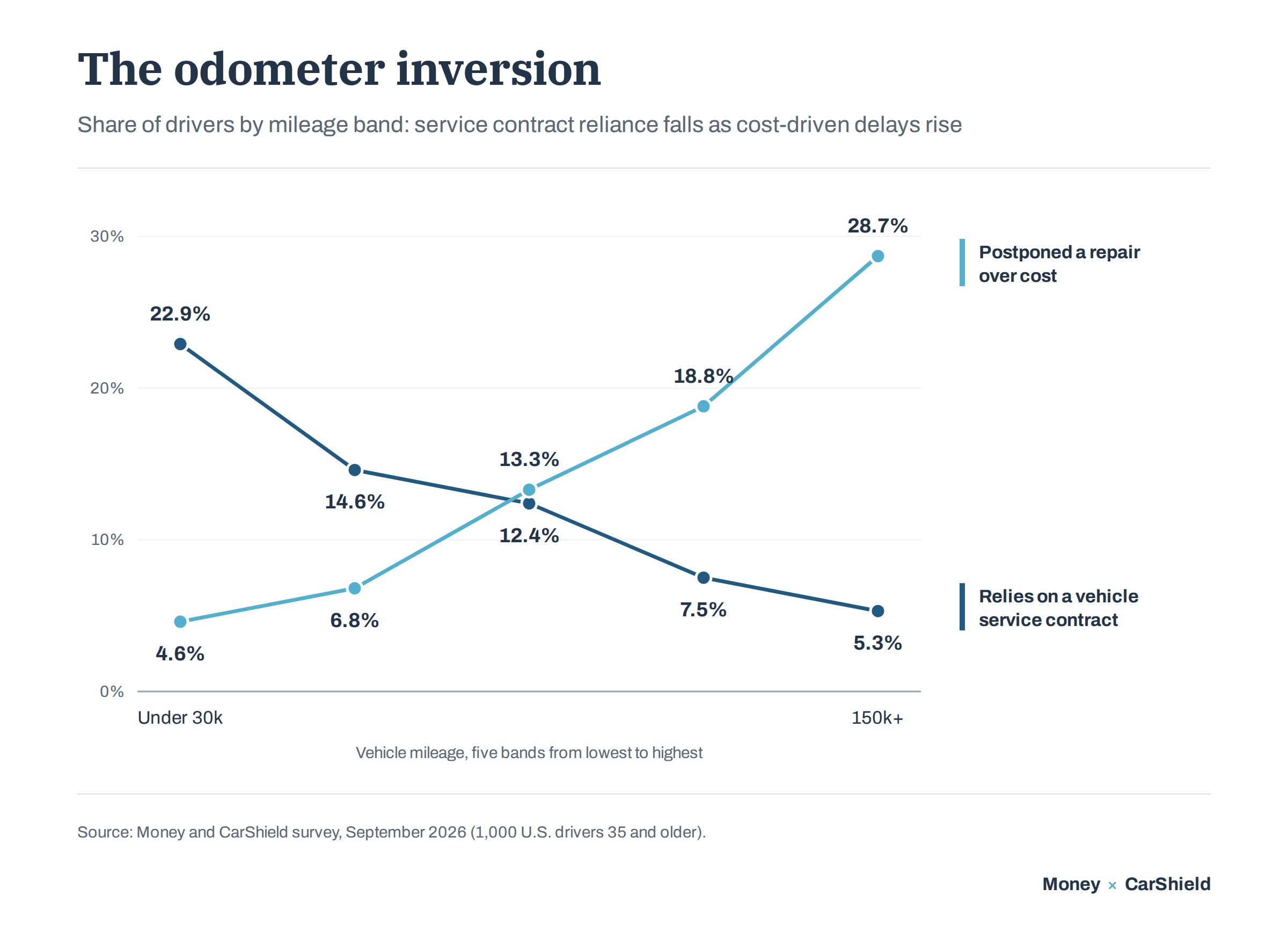
- Higher risk, less coverage: Service contract use drops from about 23% on cars under 30,000 miles to about 5% on cars with more than 150,000 miles.
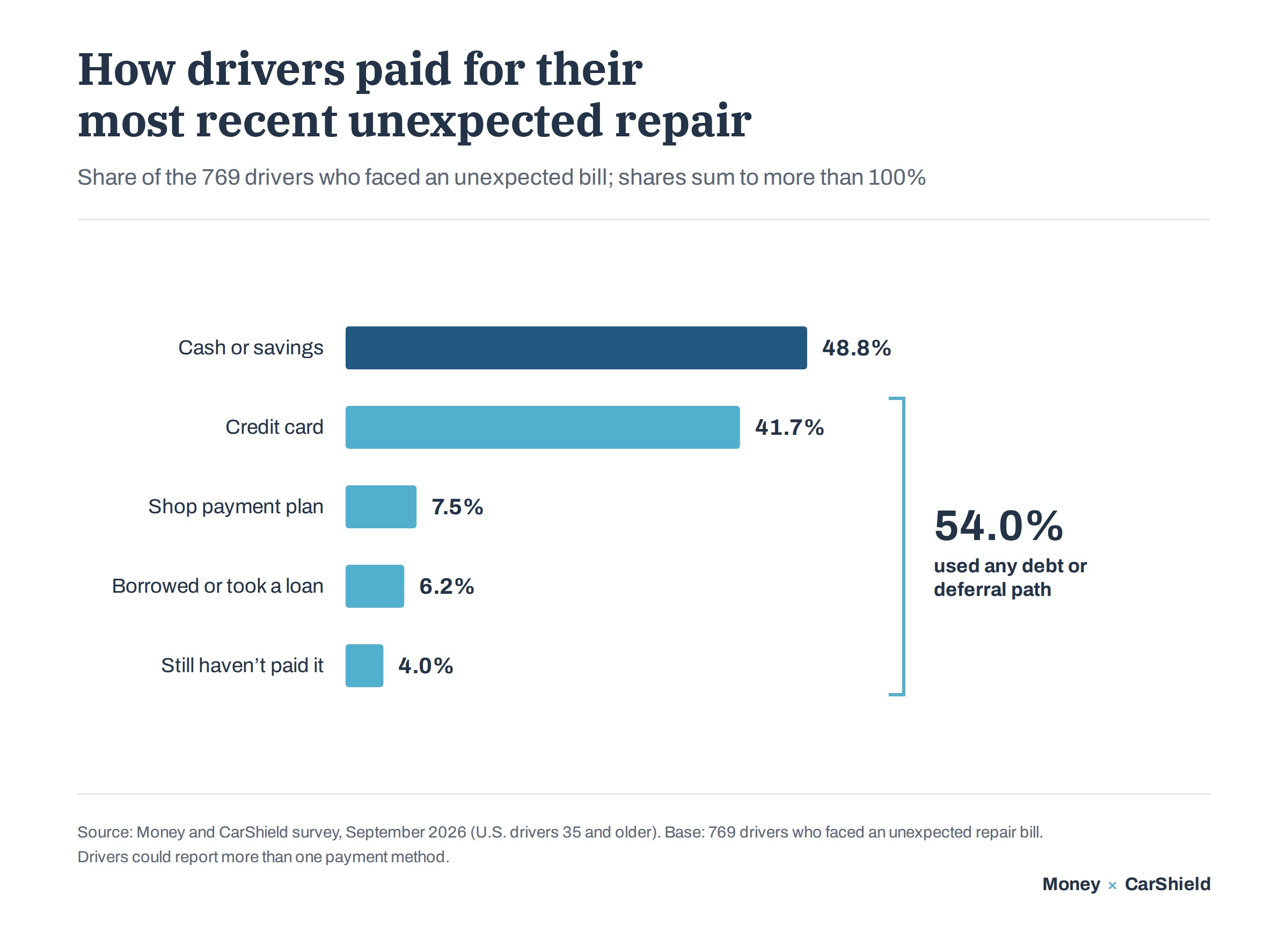
- The credit card reflex: Of 769 car owners who faced an unexpected repair bill, over 50% took on debt or deferred payments; nearly 42% used a credit card and almost 8% used a service contract.
- Not distrust — absence: Nearly 22% have never heard of a vehicle service contract; 56% of these respondents are very or extremely worried about an unexpected repair bill.
According to a September 2026 survey by CarShield and Money, of 1,000 U.S. adults aged 35 and older, nearly 59% were very or extremely worried about an unexpected repair bill, and nearly 58% don't have a plan to cover these costs.
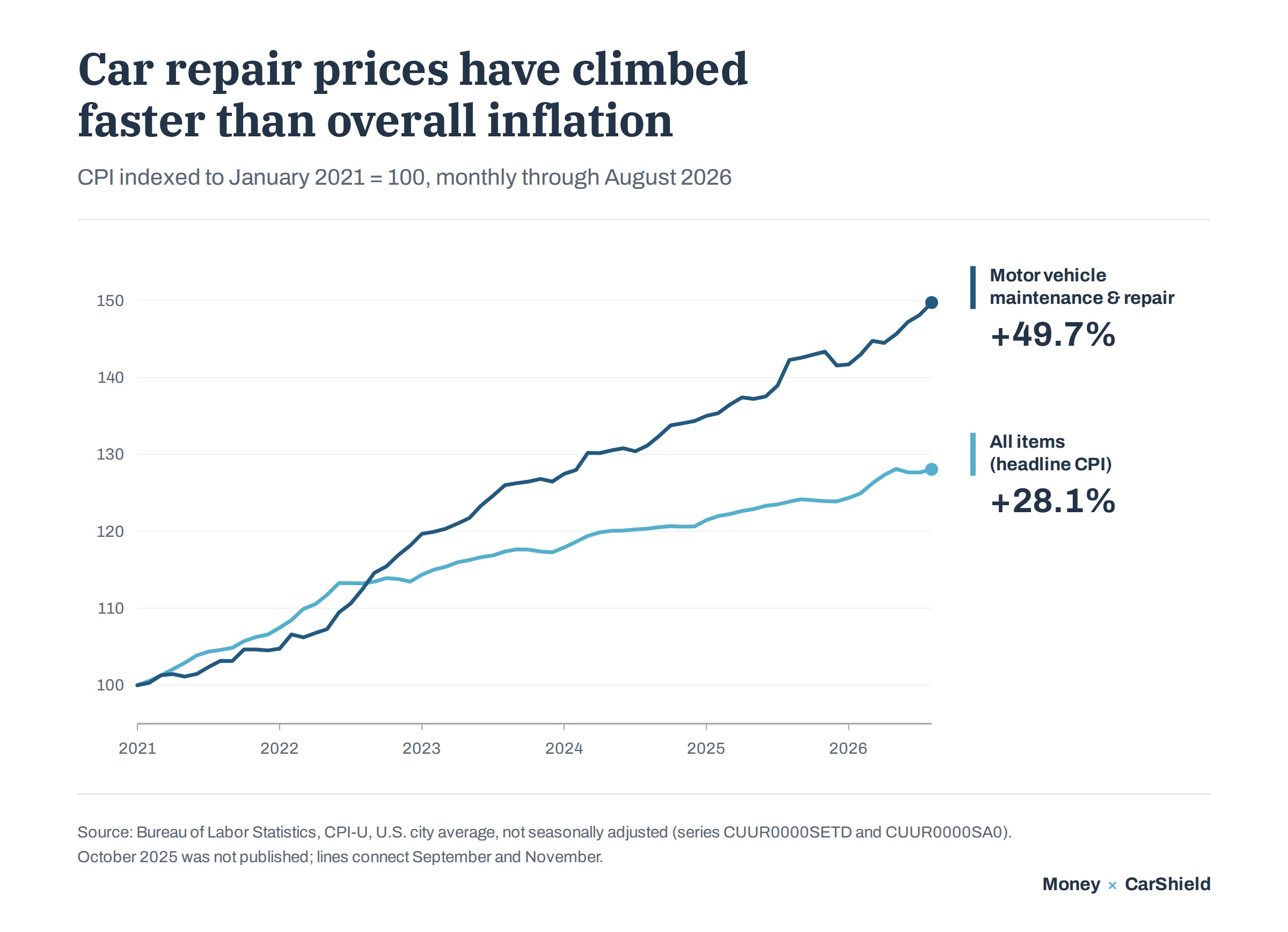
Cost is a major factor. Motor vehicle maintenance and repair costs rose about 5% in August compared to a year ago, according to the Bureau of Labor Statistics (BLS). Owners are holding onto their cars longer, which increases the risk of a major breakdown.
Have repair costs outrun what households can spend?
Motor vehicle maintenance and repair costs have increased by about 50% since January 2021, according to the BLS, outpacing overall inflation, which has risen roughly 28%. Drivers have noticed these higher repair costs, with nearly 67% of survey respondents saying they are very or extremely concerned about rising parts and labor costs.
At the same time, the average age of U.S. vehicles is nearly 13 years, according to S&P Global Mobility's 2025 report, the most recent year with available data. That number may continue to rise. Almost 43% of those surveyed by CarShield and Money expect to keep their vehicles for longer than they planned.
About 50% of respondents are very or extremely concerned about budgeting for ongoing car costs, and for good reason. The Federal Reserve's 2026 Survey of Household Economics and Decisionmaking found that 37% of U.S. adults would not be able to cover a $400 emergency expense using cash, savings or a credit card paid off at the next statement.
The same report also found that 66% of U.S. adults who had an unexpected, major vehicle repair or replacement spent at least $1,000 and 21% spent $5,000 or more.
Despite these concerns, more than 50% of vehicle owners had no plan or contract, and 41% hoped they wouldn't have to pay a major repair bill. Over 17% had no plan to manage the risk of a major breakdown.
Which cars are most likely to face a big repair bill?
Older cars with higher mileage are most likely to face a big repair bill. These high-mileage vehicles also tend to need more frequent maintenance because of normal wear and tear.
Despite the risk, many high-mileage drivers with large repair bills haven't explored options that could reduce the financial impact. Among car owners with 150,000 or more miles, nearly 32% had three or more surprise repair bills over three years, yet most haven't shopped for a service provider to help cover the costs. Nearly 79% have not shopped for any repair coverage provider.
Compare that with owners of vehicles with under 30,000 miles: About 10% of respondents have had three or more surprise repair bills in three years, while nearly 58% have not considered a repair coverage provider.
Many drivers would rather buy a new vehicle than pay to fix their current one. When faced with a $2,500 repair cost, nearly 57% of high-mileage drivers (150,000+) would replace the vehicle or start shopping for a new one, while nearly 39% of low-mileage drivers (under 30,000) would do the same.
Nearly 23% of drivers with vehicles under 30,000 miles rely on a service coverage plan — a percentage that decreases with each mileage bracket. Only about 5% of owners of vehicles with more than 150,000 miles rely on a coverage plan. Meanwhile, nearly 5% of low-mileage vehicle owners defer maintenance because of cost, compared to nearly 29% of those who own vehicles with more than 150,000 miles.
When the repair bill lands, more than 40% of drivers reach for a credit card
Among drivers hit with an unexpected repair bill, more than half took on debt or deferred payment, while almost an equal share used cash or dipped into their savings to cover the expense.
Of the 769 drivers who had a surprise repair, nearly 50% paid in cash or used their savings. Another 42% used a credit card, the second most common payment method.
Some vehicle owners used a repair shop's payment plan (nearly 8%), while others borrowed money or took out a loan (about 6%). Only 4% of those with a repair bill had not yet paid.
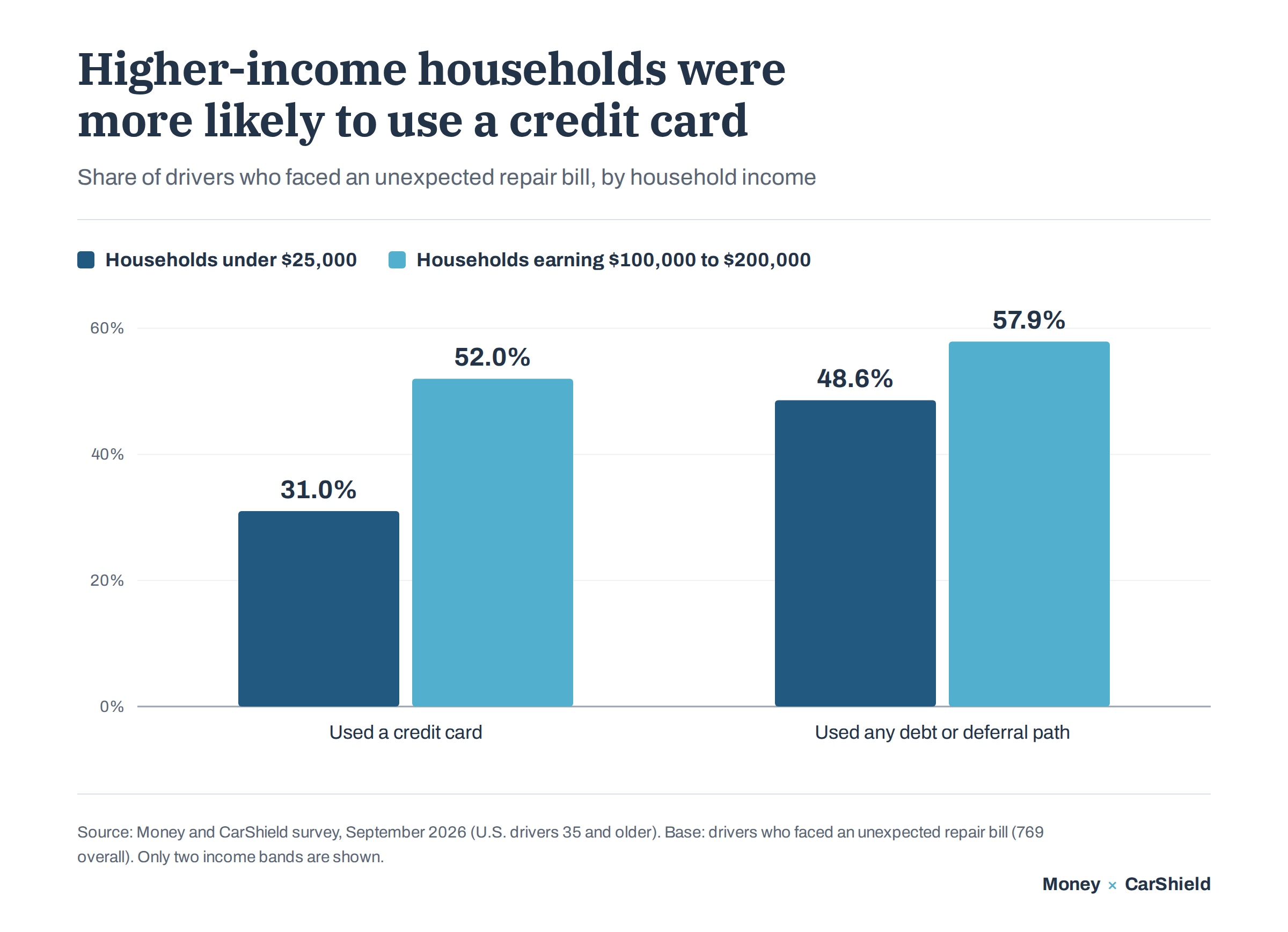
Higher-income households were more likely to take on debt or defer payment, not lower-income households. Fifty-two percent of households earning between $100,000 and $200,000 used a credit card to pay for repairs. By contrast, 31% of households earning $25,000 or less used a credit card.
Overall, nearly 49% of drivers with no service contract used some form of debt, including loans or borrowing. The disparity between income levels that opt to take on debt may suggest that the main hurdle to affording an unexpected vehicle repair is cash flow, not necessarily a lack of resources.
For recent repair costs, roughly 36% were $1,000 or more, and more than 14% were $2,000 or more. Nearly 42% of all drivers paid at least one repair bill of $1,000 or more at some point. Some drivers may choose not to repair their vehicle.
Most people don't distrust vehicle service contracts; they've never looked into one
A vehicle service contract could help car owners reduce the financial strain of a major repair to a more manageable level, but more than half of those surveyed — 53% — have little to no understanding of what these contracts could cover. That includes 22% who have never heard of service contracts at all.
A vehicle service contract is an optional agreement between a car owner and a service provider, such as a dealership, automaker or third-party company. The owner agrees to pay a deductible, much like a health insurance deductible. The service provider will pay the remaining costs for parts and labor covered under the agreement.
Of this group of 217 people, nearly 56% are very or extremely worried about an unexpected repair bill, yet nearly all of them (about 93%) haven't considered a service provider, not because of doubts about the contract itself, but simply because they are unaware of the product and how it could be helpful.
A CarShield plan can help drivers handle unexpected repair costs instead of absorbing the full bill at once. The more drivers understand how CarShield works, the better equipped they are to decide how to protect their vehicle and budget.
This lack of understanding persists even though most drivers worry about repair costs. Nearly 67% are worried about parts and labor costs.
When asked about their perception of service contracts, about 34% were very or extremely concerned about uncertainty over what a service contract covers. Nearly 12% mentioned "expensive," "costly" and "overpriced" when asked what words come to mind when talking about repair costs. Fewer than 1% used unprompted scam or fraud language when asked what comes to mind about car repair costs.
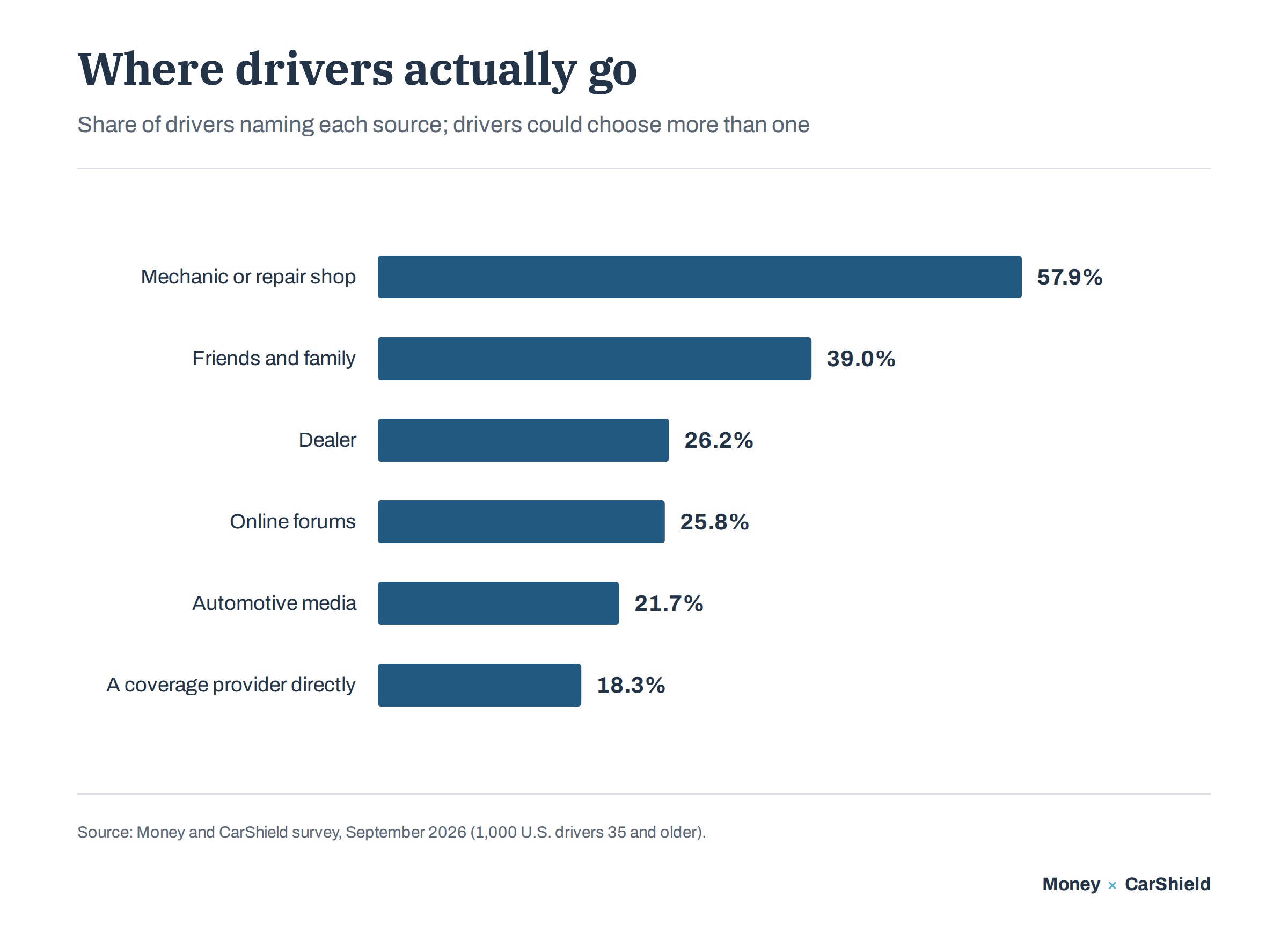
Of the roughly 47% of drivers who understand what a service contract covers, 58% learned about them through a mechanic or repair shop. 39% learned about service contracts from family or friends, while about 26% learned about them from a dealer. Car owners also learned about these contracts through online forums (nearly 26% ), automotive media (nearly 22%) and directly from a contract provider (about 18% ).
What does a vehicle service contract cover?
Vehicle service contracts cover specific mechanical and electrical repairs, such as powertrain issues, and may include roadside assistance. Which parts are covered is determined by the contract terms and the provider. You also pay a deductible — an out-of-pocket amount you pay toward an approved repair — before coverage kicks in, which varies by contract terms and provider.
According to the survey, nearly 8% of respondents used a service contract to pay for repairs. Contracts cover specific repairs, not everything. These contracts don't cover routine maintenance costs, one of the most common expenses for vehicle owners, and 77% of drivers paid for these services in the past 12 months.
Repair or replacement costs from normal wear and tear are typically also excluded from coverage, but they're not the only exclusions.
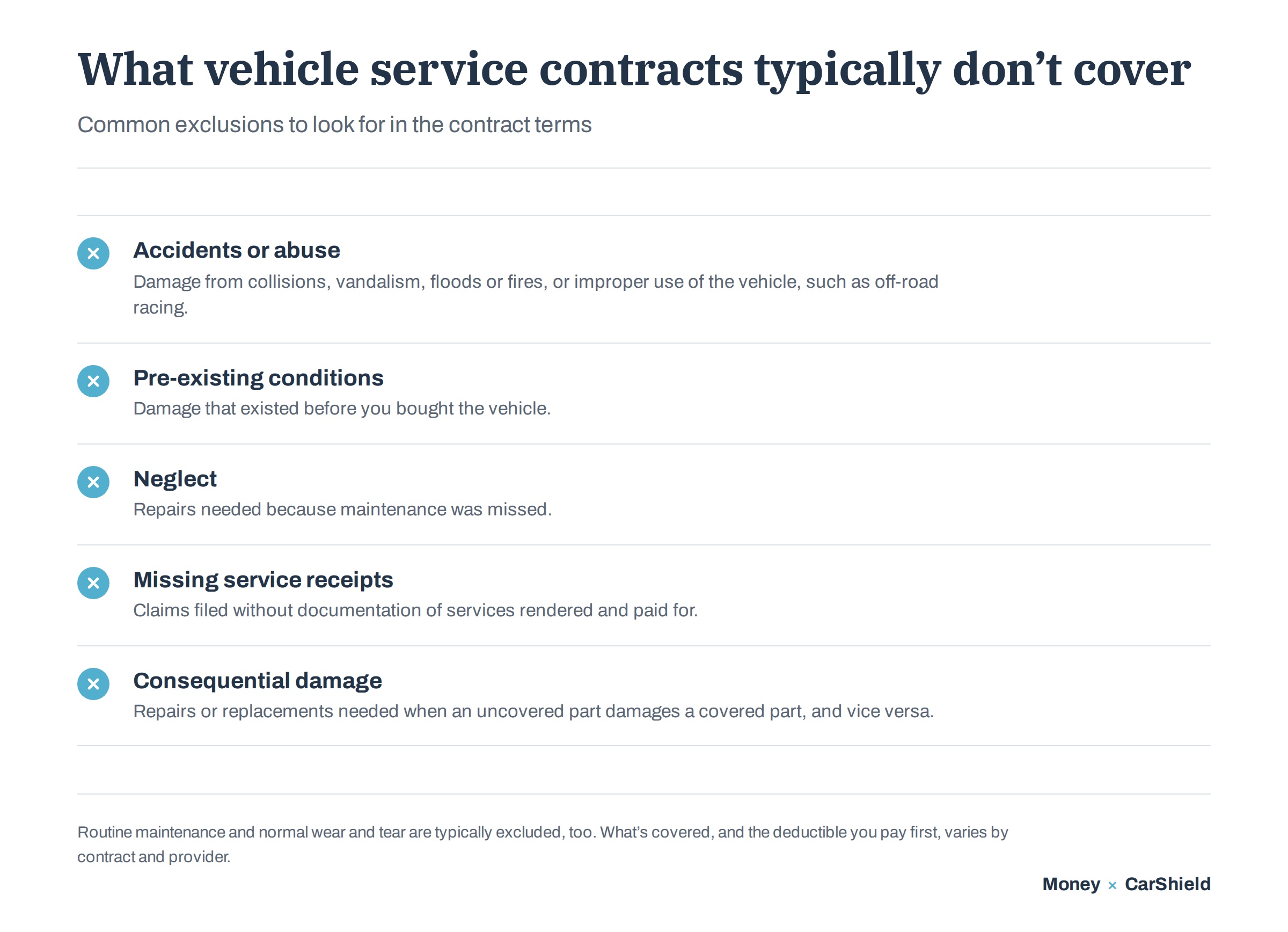
Before signing up for a vehicle service contract, make sure you fully understand its terms and conditions, what's covered, what you'll pay out of pocket before coverage kicks in and what types of damage are excluded. A service contract can cover some of the more expensive repair costs, but not all.
Methodology
AYTM Market Research conducted this survey on behalf of Money.com and CarShield between September 8 and September 9, 2026, among a national sample of 1,000 U.S. adults aged 35 and older. To qualify, respondents had to own or lease a vehicle currently, or have disposed of one in the past two years, and have personally made vehicle repair or maintenance decisions in the past 12 months. Numbers cited here are unweighted. The unweighted sample is 57.1% female, 29.3% aged 65+ and 43.1% in the South.
Selected findings draw on smaller qualified bases, reported as such — drivers who faced an unexpected repair bill (n=769), drivers unfamiliar with vehicle service contracts (n=217), drivers who rely on coverage (n=122) and drivers who answered the unaided brand question (n=916). The survey sample was 57% female, 65% aged 65 or older and 43% living in the South.